

Blog

ISHRS 2019
So today I registered for the ISHRS 2020 Virtual World Congress. That made me realize one thing: I didn’t write my blog of the 2019 one! So this will be a quick post about that.
The 2019 ISHRS World Congress was last November in Bangkok, Thailand. I’d never been there, so I was excited to check out the city. I was also tempted to hop on the plane to the islands and get some much deserved sun and relaxation at the beach, but alas, that was not possible as I was needed back in Porto and had to focus on my work.
So today I registered for the ISHRS 2020 Virtual World Congress. That made me realize one thing: I didn’t write my blog of the 2019 one! So this will be a quick post about that.
The 2019 ISHRS World Congress was last November in Bangkok, Thailand. I’d never been there, so I was excited to check out the city. I was also tempted to hop on the plane to the islands and get some much deserved sun and relaxation at the beach, but alas, that was not possible as I was needed back in Porto and had to focus on my work.

In session.
The trip itself was easy. I always enjoy these long haul flights with no internet. I get so much stuff done it’s not even funny! Just me and my books, my pen and journal, my offline email (on which I can actually clean up the inbox!), a couple of movies, etc. So yeah, I don’t want in-flight internet. Not having wi-fi for a set amount of time is actually rather enjoyable.
I try to arrive one or two days earlier to do some sight-seeing as when the congress starts it gets pretty intense, pretty soon. There’s just so many people that I’m so glad to see and hang out with that, along with the sessions, visiting exhibitors, keeping an eye on how things are going back at the clinic and how patients are doing, I barely have time to get a little workout in.
The congress itself was pretty good. There were some new topics and some not so new ones. Some things that I thought were super simple but important, such as the presentation on ergonomics (with live audience exercises!). That was a fun one. Ergonomics is something I worry about quite a bit and I do take care of my body since surgeries can be very heavy and take many hours. And since time passes super quickly, I sometimes notice I’ve been sitting in the same position for 4 hours! So it was nice to see that there was a presentation on this.
I loved the presentations from Dr. Ramon Grimalt! Super engaging and interesting. Very good and on some controversial topics. His presentations on finasteride and PRP were my favourite ones this year.

Dr. Grimalt’s talk. This slide on Post Finasteride Syndrome was so on point!
And at the end, we always have the gala dinner, which is always fun and engaging as all work is done and we finally get to relax and let loose. Some embarrassing karaoke moments from some of the attendees might have happened, but let’s just say fair play and leave it at that. :D

Hanging out by the pool at the end of the day’s sessions.
After hours, me, Dr. Josephitis and Dr. Pinto and a few others went to the most unlikely little bar right over the river. I’m not even sure if the light was on! Haha The locals were super friendly. They had a guitar with them and I even played and sang a bit with them. Good fun.
The night ended with the concierge taking us on golf-kart ride around the vicinities of the hotel (not even sure how that happened!).

Coffee time at the gala dinner.

Looking at the Wat Arun temple.
On the last day before my flight, me and my good friend Dr. Pinto went to do some sightseeing and, of course, went to get a Thai massage. We found Dr. Josephitis there who was basically addicted to massages at this point! :D The woman who did my massage was super friendly. That woman proceeded to “destroy me”. She bent me in ways I though I could not be bent! I never though someone so small could be so strong.

Dr. Josephitis, myself and Dr. Pinto.
All in all, a great congress. This year sadly there won’t be a live meeting, but a virtual one. Once again I’ll be part of the faculty in the FUE Basics course, albeit in video form. Honoured to a be part of it.

Overlooking the beautiful city. Bangkok has amazing rooftops.
Until next time!
(Hopefully in a shorter time period than the last blog.)

Beautiful lunch view from this restaurant.

The Importance of Shaving
Shaving the head of a patient who was at 5 months post-op of his first procedure to reconstruct the frontal third. He was now being prepared for his second procedure to cover the crown area. The results of the first procedure were already very noticeable.
There’s an important step that must happen in every FUE hair transplant (well, almost “every” and I’ll get into that in a bit) - shaving your head.
“What?! I have to shave my head for the surgery?!” - used to be a common reaction some years ago when I told patients we would need to shave. Nowadays, not so much. You see, hair transplants have come a very long way both in terms of results and in mainstream adoption/awareness. So, the vast majority of patients that come to me know that they generally must shave their head in order to have the surgery.
But why is that?
There are two parts of the reasoning for it and I’ll get into both of them. Firstly, shaving the donor area is needed because, in order to safely and completely extract follicular units, we must cut around them with a circular scalpel called a punch (It’s basically a very small, very little, and very sharp tube). This punch is usually just a bit wider than the diameter of the follicular unit. We cut the skin around it in order to free it from the surrounding tissue. I’m not going to get into that in this text, but Dr. José Lorenzo published great research about the hair follicle anchoring system (that we must cut to free the graft from the scalp).
So, in order to cut around it with the punch, logic makes it so that the hairs have to go inside the lumen of the punch. There is no way around it (actually there is, but again, later). So we cut that hair very short, and then it becomes super easy to do those cuts.
My personal preference is to have the hairs on the donor area super short, less than 1mm in length. I just leave enough to identify the hair and the angle at which it exits the skin. And that’s the main reason we do it.
And the recipient area?
It isn’t mandatory to shave the recipient area. Although for me it kinda is. I only don’t shave the recipient area in women and in very small cases or touch-ups. Of course, if there’s no hair in the recipient area, there’s nothing to shave, but I do like to shave the borders in order to seamlessly integrate the transplanted hair with the native hair. But why do I do it?
Because it greatly benefits my view of the area. It allows for a much more general idea of what’s happening “under the hood” so to speak. Any good engineer will tell you a great build starts with great foundations, so I like to have a very good view of the “foundations”. It also allows for better planning, better graft distributions, and reduces the risk of damaging the native hair as long hair doesn’t have the same evident angulation as short hair. It falls to whatever side it is combed to. And when you’re implanting grafts right next to those hairs, you want to be sure you’re not damaging them, causing unrecoverable shock loss. Shaving the recipient area greatly minimizes this risk.

Shaving the head of a patient who was at 5 months post-op of his first procedure to reconstruct the frontal third.
So, those are the main reasons. However, there are a few other aspects in which shaving benefits the surgery. It makes the surgery easier and quicker as you don’t have to struggle with hairs that obstruct your view or stick to the skin and crumple up with other hairs. Bloody hair is not really easy to work with, so not having to deal with that is a plus. Post-operative hygiene and care is also largely facilitated. Washing your scalp and keeping it clean, applying any needed ointments, etc, is way easier when your hair is very short. It also improves comfort and reduces any itching. It’s just that much better.
I did say that it’s not always needed to shave. There is something called long-hair FUE. It’s basically a technique that uses a punch that has a groove that allows to do the aforementioned cuts without having to introduce the hairs through the punch, thus making long hair extractions possible. In my opinion, it’s an interesting exercise but it lacks the many benefits of shaving. I think it can be an interesting technique for very small procedures, but not very useful for the majority of cases.
One thing I do sometimes in small cases and in women is to shave little parts of the donor area, creating a flap with the hair that is immediately above. This hair covers the donor area nicely, camouflaging the fact that something has been done. The shaved hair then grows back to its original length and it then looks as if nothing happened.
These are compromises we make for very select cases. But the gold standard and the absolute best course of action will always be the same: shaving.

Why Travel For Surgery?
We’re an international clinic. Patients contact us from all over the world, all the way from Australia and New Zealand (yep, literally the most distant civilization from where we’re located) to South Africa, to North America, to…well…next door. This is something I take pride in. Our philosophy revolves around very high quality of service and results, not volume.
Ok, so the first challenge for me here is to write this without it ending up sounding like an infomercial. Because of course I really enjoy having patients come from all over the world and we do get business from them. So let’s just get that “disclaimer” out of the way.
We’re an international clinic. Patients contact us from all over the world, all the way from Australia and New Zealand (yep, literally the most distant civilization from where we’re located) to South Africa, to North America, to…well…next door. This is something I take pride in. Our philosophy revolves around very high quality of service and results, not volume. So we get to really spend time with patients and actually have the privilege of learning from other cultures and experiences while doing the work we love.

Porto (OPO) Airport. Photo by Xavier Sanz (flickr.com)
I firmly believe this is way better for the patient’s experience and result, since we really end up dedicating ourselves to one case at a time, thinking thoroughly about the strategy and performing the surgery without any sense of time constraints, stopping only at the closest we can possibly get to perfection. It’s nice to see patients relaxing and totally surrendering the outcome of their surgery to us. This is the highest level of trust there is and means a lot to me.
So, with this in mind, I know other people from around the world might want to benefit from this type of experience. They might really like the results we achieve and how we achieve them. They might resonate with our philosophy and way of doing things. Or they might simply trust me and my team as their best option to fulfill their desires of achieving the hair they want to have.
And we don’t take this lightly.
When someone takes the darn to actually get up and travel to a different country to get surgery with THAT doctor at THAT specific clinic, that means they care immensely about their result and went through the work of researching who could be the best option for them. There is of course a second type of person who travels for surgery, on the basis of price. These people are usually not as well informed, not as demanding with their results and are just looking for the cheapest way of getting surgery. They don’t compare doctors, they compare prices. I guess there is a market for that and rightly so. I just advise people to do their due-diligence and please keep your health and well-being a priority.
On our end we work continuously to make the experience as seamless as possible for the patients who choose to travel to us. And we’re still developing new ways and services to improve on this. Having better and closer patient support before, during and after. Creating ways for patients to always know what their next move is and not feel like they need to figure anything out, so that they’re always at ease and comfortable. Fortunately, Portugal is a very welcoming and friendly country. Actually, Portugal is the third most peaceful country in the world according to the Global Peace Index 2020 only topped by Iceland and New Zealand. The Portuguese have this habit of going out of their own way to help strangers and try to understand even languages they don’t speak. Most of the important signs are written in multiple languages and thus tourists find it very easy to navigate around here. We also have excellent weather year-round, which should not be a deciding factor for a hair transplant, but it’s nice to have and nice to know.

Global Peace Index 2020.

The beach where I sometimes go to relax or for a run after a long day of surgery.
Our clinic is located 5 minutes away from the beach which is also a pleasant way for patients to recover from their surgery or get ready for it, even if they can only look at it during their first post-operative days. Porto the city as also won the European Best Destination award 3 times and once again, while that should not be a deciding factor, it’s nice to know/have. And since some patients are very busy and may want to bring their family during the little free time they have during the year, their family get to enjoy the city while they’re in our company.
But this is 2020, and we’re now in the midst of a pandemic. Fortunately things have improved greatly since March, which was when we had to go into lockdown and suspend all our clinical and surgical activity. We were also very fortunate here in Portugal since we were hit much less seriously than other western-European countries and I’m very glad to say that, at the point of this writing, Porto hasn’t had a new case of COVID-19 in 6 days.

Porto, Portugal
Of course traveling is still restricted and it may take a while for things to get back to a resemblance of normal, but we’re getting there. We’ve also taken many different measures to ensure safety at the clinic and thus, things have been going rather smoothly.
I can’t wait for when we’ll be able to provide our new services to our patients, but in the meantime, we’re very happy with how things are progressing and patients as well.
But the pandemic was not the focus of this article. Actually, I started writing this long before there was even a SARS-CoV-2. So, in conclusion, traveling for surgery is like traveling for any specific thing someone may wish to do or see. It’s not located where they are and thus they must travel to obtain it. Our goal is to make as enjoyable, as easy and as comfortable as possible and we continually work on that.

What's Behind a Great Hairline?
The hairline. Easily one of my favourite aspects of hair transplant surgery. It can easily define the quality of a hair transplant (although a great hair transplant is far from being just an excellent hairline) and it changes everything from the moment you decide on where to place it.
Your hair frames your face in such a profound way that a person can dramatically change his or her appearance just by getting a haircut. We’ve all had that “Wow! You got a haircut! I almost didn’t recognize you!” moment from someone we know, or even caused one ourselves with our bold new, avantgarde haircut.
The hairline is in a way, a surgeon’s signature and one of the things that distinguishes a good surgeon from a great one. It is also one of the most important parts of the surgery. Like I’ve mentioned, hairline placement can make or break a hair transplant and has the most potential to dramatically change the patient’s look…for better or worse.
The hairline. Easily one of my favourite aspects of hair transplant surgery. It can easily define the quality of a hair transplant (although a great hair transplant is far from being just an excellent hairline) and it changes everything from the moment you decide on where to place it.
Your hair frames your face in such a profound way that a person can dramatically change his or her appearance just by getting a haircut. We’ve all had that “Wow! You got a haircut! I almost didn’t recognize you!” moment from someone we know, or even caused one ourselves with our bold new, avantgarde haircut.
The hairline is in a way, a surgeon’s signature and one of the things that distinguishes a good surgeon from a great one. It is also one of the most important parts of the surgery. Like I’ve mentioned, hairline placement can make or break a hair transplant and has the most potential to dramatically change the patient’s look…for better or worse.
A great hairline can be defined by three things:
Correct placement of hairs.
Adequacy to the patient’s facial features and age.
Density and coverage.
But TL;DR, I would say that it all comes down to one thing: naturalness.
Naturalness should be the priority of every surgeon. It is the paramount outcome of any hair transplant. This is because naturalness comes from the combination of all aspects that involve a good hairline. You can’t simply get one or two things right and leave the others out of the equation. Harmony between all parameters must be achieved in order to mimic nature in a convincing way.
For example, transplanted follicular units can all be of the correct amount of hairs per graft, implantation can have the correct angulation and the hairline design can be great for the patient, but if the density is sparse, then it still risks looking unnatural. This is because in androgenetic alopecia, hair follicles in a certain area tend to get all affected in varying degrees. It just doesn’t look right to have a fully miniaturized area with thick, healthy follicular units transplanted from an area unaffected by androgens, spread over it with low density.
So we need to be really precise with our planning and not skip on any steps, or we will fail our patient.
If we try to really look attentively and dissect what a natural hairline looks like, we see that:
Hairs aren’t all the same caliber.
Follicular units don’t all have the same number of hairs and density isn’t exactly the same all over.
The hairline itself isn’t straight and hair insertion does not follow a specific pattern.
There is correlation between the frontalis muscle - which extends roughly between your eyebrows and the galea aponeurotica (think of it as what’s above your forehead) - and the insertion of the native hairline.
So lets go even deeper into it:
Hair has a tendency to be thinner in the peripheral areas (for example, hairline, temporal peaks, nape, etc) and thicker in the more central parts. We also have a very obvious distribution of follicular units that tend to increase their number of hairs from peripheral to central. So if we look to the outermost hairs, the hairs that are on the outside of the hairline, they’re all one haired follicular units and are slightly thinner than the next row of hairs. (Now, there is no such thing as “rows and files” in native hair (and there shouldn’t be in transplanted hair either - which is one of the tells of a transplant - but for the sake of illustration, let’s stick with that.)
There is a natural tendency of thinner one-haired follicular units (question: should we actually call them “follicular units” when they’re just one hair follicles?) to blend in with thicker ones as we go deeper into the hairline. The next step as we delve deeper is that we now start seeing two-haired units. You can see this in your own native hairline. (I understand the irony of asking readers to take a look at their native hairline in a hair loss and hair transplant blog. There is a good chance they don’t have it anymore. But I can tell you that more or less we still see a similar pattern in a receded hairline).
Now moving even deeper, we start to see three-haired units blend with the two-haired follicular units (and even more if you’re lucky). These contribute to coverage even if there might be slightly less density in terms of follicular units per square centimeter.
We also see that these “first hairs” aren’t exactly what defines the hairline. You see, they’re so fine that when we look at the hairline, our eyes tend to sort of skip over them and stop at the thicker two-haired units to make out where the hairline is. This is obvious in some hairlines more than others. These fine hairs do however have a crucial role in making the hairline look natural. Having a thick “wall of hair” right from the first row of hairs just doesn’t look right. They also don’t simply line up like a row of soldiers in formation. I’ve seen this in some hair transplant results. It just looks weird and is an obvious tell of a bad transplant.
So, if we look at these guys over here, we see that these rules are pretty much a constant:

Green Line: first hairs;
Red Line: more defined hairline;

Green Line: first hairs;
Red Line: more defined hairline;

Green Line: first hairs;
Red Line: more defined hairline;
The green line marks where the first fine hairs in the hairline can be seen and the red one marks the thicker, more defined zone. The last case has such a big discrepancy because he has product in his hair which makes it look wet…and damp hair has less coverage than dry hair. So his more defined hairline is not as far from the first hairs in the hairline as it looks.
Even in a case of hairline recession, the song remains the same. #seewhatIdidthere

Green Line: first hairs;
Red Line: more defined hairline;
Now, if we direct our attention to a badly transplanted hairline.

We can see how unnatural it looks. There are multiple-haired follicular units on the hairline. All the hairs are in a single file and there are no micro-irregularities with thinner hair to mimic a natural hairline. The hairline is completely see-through and this isn’t even a well lit shot.
And as I’ve mentioned, there are other things that contribute to aesthetics that aren’t the hairs on hairline itself. The facial features of the patient are also crucial for the placement and design. I personally, am not a proponent of symmetry just for the sake of symmetry. Our faces aren’t fully symmetrical, and our hairlines aren’t fully symmetrical either. One eye can be larger than the other, one eyebrow more raised or with a different shape/arch, etc, etc.
One half of a hairline isn’t simply the mirror image of the other half.
We can see this in Cristiano Ronaldo. I’m a big fan of football, by the way. So expect to see more examples with footballers in the future. :D

CR7. Portuguese national team captain and 5 time Ballon d’Or winner. #GOAT
His left side is clearly lower than his right side. His eyebrow is also higher on the right and the arch of it is different as well. And if we look even closer, we see that his eye is higher too… The whole right side of his face is slightly more raised than the left. This asymmetry is perfectly normal. I’m just pointing it out to explain why we shouldn’t just look at a patient’s forehead when designing his hairline.
Another thing to be mindful of are the temporal peaks. These are often ignored, yet they’re crucial for the overall look of the hairline as they’re a big part of the frame of your face. Those little triangles of very fine hair on each side of your temples are so important that they’re usually a big tell of either a hairpiece or a badly designed hair transplant. You see, even for someone who hasn’t got a clue about a natural hairline, when they see receded temporal peaks that are almost flat, but a full head of hair with a medium to low hairline…something just doesn’t look right. It creates a kind of a “lid effect” that is a dead giveaway of one of the aforementioned two.
Temporal peaks usually can make a hairline look much lower or higher than it actually is, just by their positioning - more frontal (shortening the distance between each contralateral peak) or more posterior (increasing their distance). We can rapidly infer from this that the closer they’re together, the smaller the forehead looks and the wider they’re positioned, the opposite occurs.
We can see this pretty clearly if we look at Leonardo DiCaprio and Brad Pitt. This was actually pointed out to me by Dr. Jose Lorenzo when we were discussing hairlines and temporal peaks.

Brad Pitt and Leonardo DiCaprio. Two amazing actors.
If we look closely, the distance from the glabella (between the eyebrows) to the center of the hairline is practically the same. Leo’s might be even shorter, meaning, his hairline might actually be lower than Pitt’s. Yet, Dicaprio’s hairline looks much higher and his forehead much larger. This can be attributed to the temporal peaks. See how much more pronounced and closer together Pitt’s eyebrows are? Now, to be fair, Dicaprio does have slightly more recession on the sides and his face is a bit rounder. However, it’s the positioning of the temporal peaks the biggest contributor to this little difference.

Leo has (finally) won an Oscar. When will Brad’s turn be?
So, temporal peaks are something that should always be addressed. The hairline should flow in an harmonious way from one side of the face to the other. And as a rule of thumb, the lower the hairline, the closer together the temporal peaks should be.
This does not mean however that we always have to rebuild or even touch the temporal peaks as a lot of men do conserve them. Which is great, since these are one of the most challenging parts of the surgery. Hairs are very fine and exit the skin at a very acute angle, almost parallel to the surface. The surgeon must first find out where to harvest similar caliber hair (which isn’t always easy) and then he has to be skilled and meticulous when placing them in the correct angulation (which usually means using a different technique), in very thin skin, at a very shallow depth, whilst ensuring survival of super delicate grafts. Holy precision Batman!
There’s a world of possibilities and things to get into when discussing hairlines (like widow’s peaks, cowlicks, centrifugal versus centripetal fanning, etc), but these are a few of the aspects I find most important to a well designed hairline and that I wanted to share with you in this post.
And as I pointed out at the begging of this article, naturalness is paramount. Everything that brings us closer to it, brings us closer to a better, more aesthetically pleasing hair transplant. A badly designed hairline is unacceptable for today’s hair transplant standards and patients should ensure that their surgeon is skilled in not only advising them, but also delivering the results. And bearing that in mind, we should always remember: better to be bald in a natural way than to have an unnatural hair transplant.

How Hair Transplants Work
Hair transplants have progressed a lot over the years. We have gone from being very limited in what we were able to do for patients, doing sometimes painful surgery which would leave ugly scars and unnatural results to virtually undetectable, very natural looking results with short recovery times.
Hair transplants have progressed a lot over the years. We have gone from being very limited in what we were able to do for patients, doing sometimes painful surgery which would leave ugly scars and unnatural results to virtually undetectable, very natural looking results with short recovery times.
But the principle has always remained the same: hair transplants have always been a procedure of moving autologous (i.e. obtained from the self) hair producing follicles from one place to another. A process also known as grafting. In most cases (but not always) they’re moved from areas of higher density in the scalp located in the temporal, parietal and occipital zones (usually what we describe as the Safe Donor Area) to areas that are in (frequently desperate :P) need of hair.
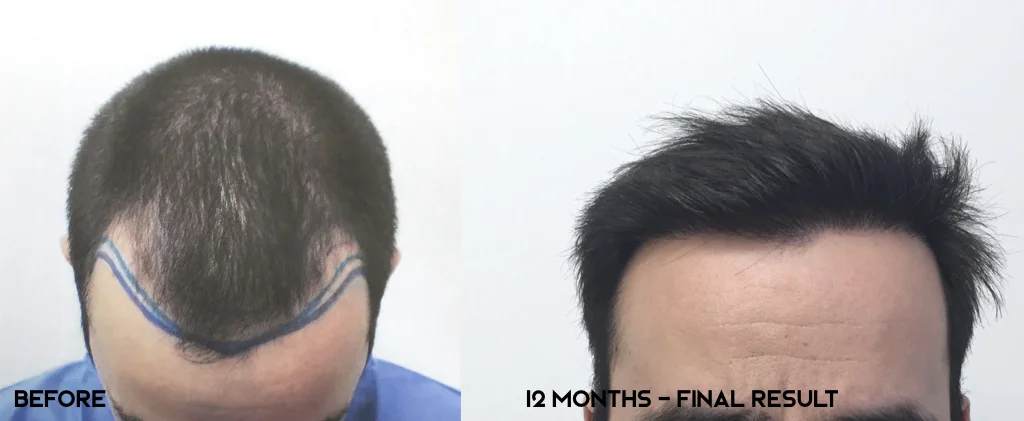
One of our results.
So, grafting relies on the body’s ability to regenerate from damage. This is why we can cut tiny grafts of hair follicle containing skin and implant them in the desired areas. After about 48 hours, vessels from the recipient area are already starting to connect with the vessels from the grafts and at about 3-5 days post-op, new blood vessels are forming - a process known as neovascularization.
Looking at the other end, it also relies on the graft’s ability to be cut off from blood supply (ischemia) for multiple hours and still survive. This is a process which we have refined over the years by manipulating temperature and the medium in which they are momentarily placed for storage. The cell metabolism slows down to a crawl and in a way they go into a power-saving mode. - like when my Apple Watch has almost no battery and only lets me check the time. It’s still on, but it’s hanging on for its life to the little juice it has.
Refrigerated quad Petri dish containing grafts separated by number of hairs.
It is only when these two aspects (neovascularization and recovery from ischemia) intersect that the grafts will take and grow normally in their new “home”, allowing us to do the marvelous work we’re so privileged to do.
Another completely crucial aspect of a hair transplant is of course the knowledge and technical ability of surgeon and team to perform all steps the surgery whilst ensuring that the grafts survive. They have to do it all without crushing, transecting, breaking or stripping the grafts, letting them desiccate, losing them (yes, losing them), getting them too cold or too warm, etc etc (there are quite a few ways of damaging such small and delicate structures and damage to grafts is one of the most common causes for low graft survival).
Here I am implanting grafts into the crown area of this patient.
So, whilst hair transplants are becoming more and more popular, they’re still an organ transplant, and should be treated with the care and respect due to something that is finite and non-renewable. Once they’re gone, they’re gone and being diligent in ensuring survival is the only way that a hair transplant works in the first place.
And of course, we can only say that they “work” when they actually provide natural, aesthetically pleasing results. But that goes into a different aspect of hair transplants that I would like to get to in another post.