

Blog

No Two Hair Transplants Are The Same
Why is it important to do a personalized, bespoke and detailed approach to a hair transplant and why a one-size-fits-all approach doesn’t work.
Why is it important to do a personalized, bespoke and detailed approach to a hair transplant and why a one-size-fits-all approach doesn’t work.
A hair transplant is a very personal thing. No two heads are alike. There are many, many variables to take in account when performing a hair transplant. One variable can change everything. And that’s just for planning. When you actually go to work, everything can change once more.
I keep saying this, but it’s worth mentioning because it’s true: there are tens of different parameters I evaluate in a single patient before I even decide if he’s a candidate for surgery. Some I assess in a more conscious way than others, but they all are accounted for. All those variables are computed (in my head) to establish a diagnosis, a strategy, a plan, a timeline and a prognosis.
Things like the patient’s age, the level of agressiveness and activity of his alopecia, the patient’s family history of hair loss, medications or other environmental factors he could be exposed to. The patient’s wishes and expectations as well as his/her psychological ability to be subject to a surgery or multiple surgeries. The patient’s hair characteristics, donor surface area, caliber, coverage value, etc, etc, etc. The list goes on and on...
Of course there are similar cases. But whenever I show a patient a case from another patient, it’s always just a reference of what’s possible. Consistency in results is very important for me. It’s very important to give a patient a prognosis that I feel comfortable in achieving. I do err on the side of underpromising, as I think that evens out the patient’s expectations. So It’s always super nice to see the patient’s reaction when we overdeliver. ;)
But the way of getting those consistent results is totally different from one patient to another. That’s why it’s sometimes difficult to explain to a patient that I’m taking a different strategy or using a different process or instrument to achieve his/her result. In the patient’s mind, he/she is thinking “but you used x process to get that great result I saw. I’d like to use the same to get the same result.”
It doesn’t work like that.
I’ll go as far as to say that if you use the same exact process for all patients, you’ll start to get below average results. Complacency will start to show and you may get a few good results, but also a lot of sub-par results.
Patients need different processes/strategies/instruments/etc according to their specific case. And I’m not even talking about when complications arise and you have to get creative.
So yes, no two transplants are alike. And a very detailed, bespoke, personalized approach is not only much more pleasant for the patient. It’s needed! ...at least if you want to get high quality results.
I also think it would make my job super boring to just do the same thing over and over. Rinse and repeat. We’re not EA. :P
So, I change things up. I try new things. I get creative and by doing that I develop more skills for my “bag of tricks”. Always remembering habit #7:
“Sharpen the Saw” ;)
Until next time,

What's Behind a Great Hairline?
The hairline. Easily one of my favourite aspects of hair transplant surgery. It can easily define the quality of a hair transplant (although a great hair transplant is far from being just an excellent hairline) and it changes everything from the moment you decide on where to place it.
Your hair frames your face in such a profound way that a person can dramatically change his or her appearance just by getting a haircut. We’ve all had that “Wow! You got a haircut! I almost didn’t recognize you!” moment from someone we know, or even caused one ourselves with our bold new, avantgarde haircut.
The hairline is in a way, a surgeon’s signature and one of the things that distinguishes a good surgeon from a great one. It is also one of the most important parts of the surgery. Like I’ve mentioned, hairline placement can make or break a hair transplant and has the most potential to dramatically change the patient’s look…for better or worse.
A great hairline can be defined by three things:
Correct placement of hairs.
Adequacy to the patient’s facial features and age.
Density and coverage.
But TL;DR, I would say that it all comes down to one thing: naturalness.
Naturalness should be the priority of every surgeon. It is the paramount outcome of any hair transplant. This is because naturalness comes from the combination of all aspects that involve a good hairline. You can’t simply get one or two things right and leave the others out of the equation. Harmony between all parameters must be achieved in order to mimic nature in a convincing way.
For example, transplanted follicular units can all be of the correct amount of hairs per graft, implantation can have the correct angulation and the hairline design can be great for the patient, but if the density is sparse, then it still risks looking unnatural. This is because in androgenetic alopecia, hair follicles in a certain area tend to get all affected in varying degrees. It just doesn’t look right to have a fully miniaturized area with thick, healthy follicular units transplanted from an area unaffected by androgens, spread over it with low density.
So we need to be really precise with our planning and not skip on any steps, or we will fail our patient.
If we try to really look attentively and dissect what a natural hairline looks like, we see that:
Hairs aren’t all the same caliber.
Follicular units don’t all have the same number of hairs and density isn’t exactly the same all over.
The hairline itself isn’t straight and hair insertion does not follow a specific pattern.
There is correlation between the frontalis muscle - which extends roughly between your eyebrows and the galea aponeurotica (think of it as what’s above your forehead) - and the insertion of the native hairline.
So lets go even deeper into it:
Hair has a tendency to be thinner in the peripheral areas (for example, hairline, temporal peaks, nape, etc) and thicker in the more central parts. We also have a very obvious distribution of follicular units that tend to increase their number of hairs from peripheral to central. So if we look to the outermost hairs, the hairs that are on the outside of the hairline, they’re all one haired follicular units and are slightly thinner than the next row of hairs. (Now, there is no such thing as “rows and files” in native hair (and there shouldn’t be in transplanted hair either - which is one of the tells of a transplant - but for the sake of illustration, let’s stick with that.)
There is a natural tendency of thinner one-haired follicular units (question: should we actually call them “follicular units” when they’re just one hair follicles?) to blend in with thicker ones as we go deeper into the hairline. The next step as we delve deeper is that we now start seeing two-haired units. You can see this in your own native hairline. (I understand the irony of asking readers to take a look at their native hairline in a hair loss and hair transplant blog. There is a good chance they don’t have it anymore. But I can tell you that more or less we still see a similar pattern in a receded hairline).
Now moving even deeper, we start to see three-haired units blend with the two-haired follicular units (and even more if you’re lucky). These contribute to coverage even if there might be slightly less density in terms of follicular units per square centimeter.
We also see that these “first hairs” aren’t exactly what defines the hairline. You see, they’re so fine that when we look at the hairline, our eyes tend to sort of skip over them and stop at the thicker two-haired units to make out where the hairline is. This is obvious in some hairlines more than others. These fine hairs do however have a crucial role in making the hairline look natural. Having a thick “wall of hair” right from the first row of hairs just doesn’t look right. They also don’t simply line up like a row of soldiers in formation. I’ve seen this in some hair transplant results. It just looks weird and is an obvious tell of a bad transplant.
So, if we look at these guys over here, we see that these rules are pretty much a constant:

Green Line: first hairs;
Red Line: more defined hairline;

Green Line: first hairs;
Red Line: more defined hairline;

Green Line: first hairs;
Red Line: more defined hairline;
The green line marks where the first fine hairs in the hairline can be seen and the red one marks the thicker, more defined zone. The last case has such a big discrepancy because he has product in his hair which makes it look wet…and damp hair has less coverage than dry hair. So his more defined hairline is not as far from the first hairs in the hairline as it looks.
Even in a case of hairline recession, the song remains the same. #seewhatIdidthere

Green Line: first hairs;
Red Line: more defined hairline;
Now, if we direct our attention to a badly transplanted hairline.

We can see how unnatural it looks. There are multiple-haired follicular units on the hairline. All the hairs are in a single file and there are no micro-irregularities with thinner hair to mimic a natural hairline. The hairline is completely see-through and this isn’t even a well lit shot.
And as I’ve mentioned, there are other things that contribute to aesthetics that aren’t the hairs on hairline itself. The facial features of the patient are also crucial for the placement and design. I personally, am not a proponent of symmetry just for the sake of symmetry. Our faces aren’t fully symmetrical, and our hairlines aren’t fully symmetrical either. One eye can be larger than the other, one eyebrow more raised or with a different shape/arch, etc, etc.
One half of a hairline isn’t simply the mirror image of the other half.
We can see this in Cristiano Ronaldo. I’m a big fan of football, by the way. So expect to see more examples with footballers in the future. :D

CR7. Portuguese national team captain and 5 time Ballon d’Or winner. #GOAT
His left side is clearly lower than his right side. His eyebrow is also higher on the right and the arch of it is different as well. And if we look even closer, we see that his eye is higher too… The whole right side of his face is slightly more raised than the left. This asymmetry is perfectly normal. I’m just pointing it out to explain why we shouldn’t just look at a patient’s forehead when designing his hairline.
Another thing to be mindful of are the temporal peaks. These are often ignored, yet they’re crucial for the overall look of the hairline as they’re a big part of the frame of your face. Those little triangles of very fine hair on each side of your temples are so important that they’re usually a big tell of either a hairpiece or a badly designed hair transplant. You see, even for someone who hasn’t got a clue about a natural hairline, when they see receded temporal peaks that are almost flat, but a full head of hair with a medium to low hairline…something just doesn’t look right. It creates a kind of a “lid effect” that is a dead giveaway of one of the aforementioned two.
Temporal peaks usually can make a hairline look much lower or higher than it actually is, just by their positioning - more frontal (shortening the distance between each contralateral peak) or more posterior (increasing their distance). We can rapidly infer from this that the closer they’re together, the smaller the forehead looks and the wider they’re positioned, the opposite occurs.
We can see this pretty clearly if we look at Leonardo DiCaprio and Brad Pitt. This was actually pointed out to me by Dr. Jose Lorenzo when we were discussing hairlines and temporal peaks.

Brad Pitt and Leonardo DiCaprio. Two amazing actors.
If we look closely, the distance from the glabella (between the eyebrows) to the center of the hairline is practically the same. Leo’s might be even shorter, meaning, his hairline might actually be lower than Pitt’s. Yet, Dicaprio’s hairline looks much higher and his forehead much larger. This can be attributed to the temporal peaks. See how much more pronounced and closer together Pitt’s eyebrows are? Now, to be fair, Dicaprio does have slightly more recession on the sides and his face is a bit rounder. However, it’s the positioning of the temporal peaks the biggest contributor to this little difference.

Leo has (finally) won an Oscar. When will Brad’s turn be?
So, temporal peaks are something that should always be addressed. The hairline should flow in an harmonious way from one side of the face to the other. And as a rule of thumb, the lower the hairline, the closer together the temporal peaks should be.
This does not mean however that we always have to rebuild or even touch the temporal peaks as a lot of men do conserve them. Which is great, since these are one of the most challenging parts of the surgery. Hairs are very fine and exit the skin at a very acute angle, almost parallel to the surface. The surgeon must first find out where to harvest similar caliber hair (which isn’t always easy) and then he has to be skilled and meticulous when placing them in the correct angulation (which usually means using a different technique), in very thin skin, at a very shallow depth, whilst ensuring survival of super delicate grafts. Holy precision Batman!
There’s a world of possibilities and things to get into when discussing hairlines (like widow’s peaks, cowlicks, centrifugal versus centripetal fanning, etc), but these are a few of the aspects I find most important to a well designed hairline and that I wanted to share with you in this post.
And as I pointed out at the begging of this article, naturalness is paramount. Everything that brings us closer to it, brings us closer to a better, more aesthetically pleasing hair transplant. A badly designed hairline is unacceptable for today’s hair transplant standards and patients should ensure that their surgeon is skilled in not only advising them, but also delivering the results. And bearing that in mind, we should always remember: better to be bald in a natural way than to have an unnatural hair transplant.

How Hair Transplants Work
Hair transplants have progressed a lot over the years. We have gone from being very limited in what we were able to do for patients, doing sometimes painful surgery which would leave ugly scars and unnatural results to virtually undetectable, very natural looking results with short recovery times.
Hair transplants have progressed a lot over the years. We have gone from being very limited in what we were able to do for patients, doing sometimes painful surgery which would leave ugly scars and unnatural results to virtually undetectable, very natural looking results with short recovery times.
But the principle has always remained the same: hair transplants have always been a procedure of moving autologous (i.e. obtained from the self) hair producing follicles from one place to another. A process also known as grafting. In most cases (but not always) they’re moved from areas of higher density in the scalp located in the temporal, parietal and occipital zones (usually what we describe as the Safe Donor Area) to areas that are in (frequently desperate :P) need of hair.
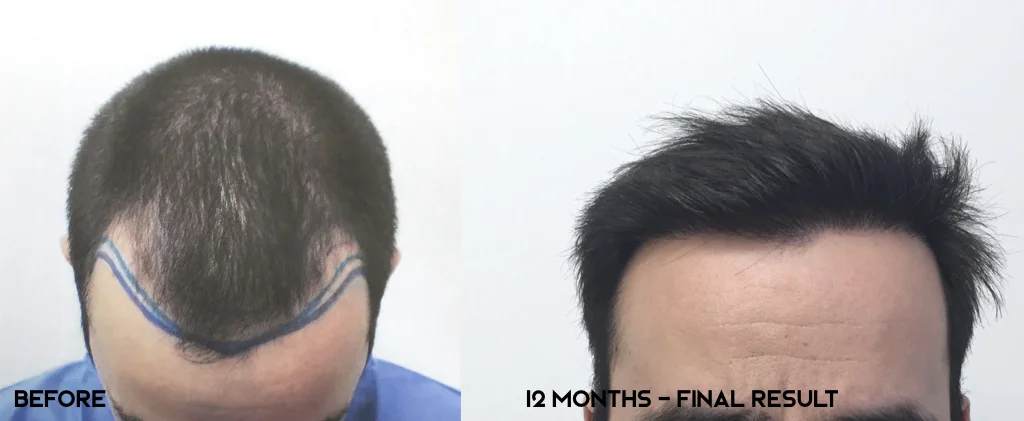
One of our results.
So, grafting relies on the body’s ability to regenerate from damage. This is why we can cut tiny grafts of hair follicle containing skin and implant them in the desired areas. After about 48 hours, vessels from the recipient area are already starting to connect with the vessels from the grafts and at about 3-5 days post-op, new blood vessels are forming - a process known as neovascularization.
Looking at the other end, it also relies on the graft’s ability to be cut off from blood supply (ischemia) for multiple hours and still survive. This is a process which we have refined over the years by manipulating temperature and the medium in which they are momentarily placed for storage. The cell metabolism slows down to a crawl and in a way they go into a power-saving mode. - like when my Apple Watch has almost no battery and only lets me check the time. It’s still on, but it’s hanging on for its life to the little juice it has.
Refrigerated quad Petri dish containing grafts separated by number of hairs.
It is only when these two aspects (neovascularization and recovery from ischemia) intersect that the grafts will take and grow normally in their new “home”, allowing us to do the marvelous work we’re so privileged to do.
Another completely crucial aspect of a hair transplant is of course the knowledge and technical ability of surgeon and team to perform all steps the surgery whilst ensuring that the grafts survive. They have to do it all without crushing, transecting, breaking or stripping the grafts, letting them desiccate, losing them (yes, losing them), getting them too cold or too warm, etc etc (there are quite a few ways of damaging such small and delicate structures and damage to grafts is one of the most common causes for low graft survival).
Here I am implanting grafts into the crown area of this patient.
So, whilst hair transplants are becoming more and more popular, they’re still an organ transplant, and should be treated with the care and respect due to something that is finite and non-renewable. Once they’re gone, they’re gone and being diligent in ensuring survival is the only way that a hair transplant works in the first place.
And of course, we can only say that they “work” when they actually provide natural, aesthetically pleasing results. But that goes into a different aspect of hair transplants that I would like to get to in another post.

Why I Divide My Bigger Cases into Multiple Sessions and Multiple Procedures
With the trend of the “mega session”, we’ve started seeing thousands of grafts being transplanted in a single session. 4000, 5000, 6000 (!) grafts being transplanted in a single day of surgery. That’s quite a feat! This means, in theory, that patients are able to restore their hair quicker and by spending less calendar time. But one question comes to mind when so many grafts are transplanted in a single session: how do the results compare?
With the trend of the “mega session”, we’ve started seeing thousands of grafts being transplanted in a single session. 4000, 5000, 6000 (!) grafts being transplanted in a single day of surgery. That’s quite a feat! This means, in theory, that patients are able to restore their hair quicker and by spending less calendar time. But one question comes to mind when so many grafts are transplanted in a single session: how do the results compare?
There are a few variables to bear in mind when considering this.
Firstly, we have to consider the quality of the donor area. Is the donor area large and dense enough to withstand having 4000+ grafts extracted without damaging adjacent follicular units and/or being subject to excessive scarring, or even worse, necrosis?
And this is not just for one session VS two sessions. This is for one procedure versus multiple procedures. It’s better for healing and donor preservation to be gentle with the donor area. Not to risk over-harvesting and depletion. When we plan multiple procedures, we have a clearer view of the donor area and can achieve better homogenization.
We need to also consider the team. How big and experienced is the team. Fatigue is a real thing. We must consider this when planning a strategy for a hair transplant. A larger team will get less tired, but it’s harder and more expensive to gather a team within which all members are very experienced.
Still on the subject of fatigue, we must not forget that patients get tired too.There are only so many hours a patient can patiently (pun intended :)) withstand of surgery. When the patient starts to get impatient (I did it again :P), or worse, when complications arise (popping, bleeding, etc), you still have all theses grafts you’ve extracted to implant. And they absolutely have to be put back into the patient’s skin. Which makes us think of the next thing to bear in mind: Ex-vivo time.
Ex-vivo time, time grafts spend out of the body. The more grafts you extract, the longer the surgery is going to take, the longer those grafts are going to stay out of the body. After a certain amount of hours, survival starts to decrease. We must consider this as well.
When I’m performing surgery, my goal is to have the last graft extracted and implanted with the same quality and mindfulness as the first one. When we have more time to do the same work (and mind you, surgeries are still pretty intense) we tend to do better work. The team’s happier, the patient’s more relaxed, the whole experience is just much better and easier for everyone. And, of course: results are better!
That’s why I much prefer to divide surgeries larger than 2000-2500 grafts into 2 sessions. It gives us time to think, to double-check, to not rush, to have a chat and a laugh between ourselves and with the patient. I think it’s better to transplant 4000 grafts over 2 days and have 100% of those grafts survive than to transplant 5000 grafts in one day and have a fraction of those survive. It’s definitely not as profitable, but profit is not our priority. Results are.