

Blog

Reflecting upon this year’s ISHRS World Congress
I guess I just repeat myself a lot when talking about these meetings, but I have to say it every time: the ISHRS World Congress is always amazing for me! I just love it. You get to see your friends, hang out and talk about hair the whole time (but not just hair, of course). There are a lot of discussions, ideas and “pearls” floating around the whole time. It’s just a privilege and I’m so happy that I get to be part of it all!
I guess I just repeat myself a lot when talking about these meetings, but I have to say it every time: the ISHRS World Congress is always amazing for me! I just love it. You get to see your friends, hang out and talk about hair the whole time (but not just hair, of course). There are a lot of discussions, ideas and “pearls” floating around the whole time. It’s just a privilege and I’m so happy that I get to be part of it all!
This year was special for me. The congress was held in my home country - Portugal. And I got to be the go to guy (or one of them) for my friends to find cool places to visit and stuff to do. Actually, some are still visiting as I write this. There’s just this pride I take in sharing my culture and our way of life with people from around the world. I can’t get enough of it.

April 25th Bridge by night.
There’s of course, the “elephant in the room”, i.e., COVID-19.
Yes, this was a smaller meeting than usual due to a lot of us not being able to come, but also an awesome win for us since we were having trouble figuring out if we’d be able to do it when we first started discussing it. Fortunately everything went without a hitch and I’m happy to say that there were no reported incidents during the meeting. A lot of work went into planning and I’m delighted with the result.

Respecting safe distancing. It was a very big auditorium with lots of space.
I had the honor of being part of the scientific planning committee and sharing my thoughts and ideas, as well as offering my help and collaboration in what I could be of assistance. Of course, being a local and Portuguese native allowed me to get quick updates, especially about COVID-related rules and guidelines. But I must say that Melanie Stancampiano, the Programs Director did such a good job that that made me almost redundant. Haha

During out panel discussion. Left to right: Dr. Washenik, Dr. Nader, Dr. Zontos, Dr. Harris and myself.
Scientifically, this was a super interesting congress. Dr. Marie Schambach, Program Chair, did a stellar job and there were a lot of insightful moments with great interactions. She’s a great doctor who has brought a lot to the scientific community, thus she had set her own bar pretty high. And she totally nailed it! Congratulations to her.
I’ll talk more about the news in the scientific part of things in a later post.
As for me, I played a small part this year in the discussions as a panelist. They always feel too short when you’re up there and you always want to do more. But that’s how it goes. Time is of the essence and we need to keep the “show” on time. Needless to say that I’m super happy about the invitation and I hope I brought something useful to the discussions with my contribution.

The customary “poster” photo with myself, Dr. Pinto, Dr. Junior and Dr. Costa
And of course, it was fun! I spoke to many great people and I made new friends and acquaintances during these days. I really appreciate those of you who took the initiative of coming to introduce yourselves to me. I am honored that you enjoy my work and I hope I’ve offered something useful to you in our chats.
We also got to share some “quality time”, going for dinner and drinks. Being it “hittin’ the town” (;D), at the cocktail reception or the Gala Dinner. It’s so much fun! I sometimes almost have to pinch myself to believe that this is my life. And I’ve missed this. I’ve missed it a lot…
And now, I’m taking a couple days off to relax a bit. But I am super Pumped to get back into that O.R. and smash some amazing results for my patients! Got some amazing ideas out of this meeting (all written down of course) and you’ll be benefiting from those really soon.
Until next time,
PS: Oh, and look at how skillful these doctors are! :P As pointed out by Dr. Mejia, here’s a before and after:

Before

After :p

ISHRS World Congress - October 21-23, 2021
Traveling to Lisbon today for the ISHRS World Congress. I've been going to these for a while now. And this time I get to be a bit of host in my home country. :) It's an honor to have many of my esteemed colleagues with me in Portugal. Unfortunately, many could not make it due to the pandemic but will join us online.
I'm excited with the topics we're discussing in this year's program and hope to bring you some interesting updates from the world of trichology and hair restoration surgery.
I'll also be part of the discussion panel for the "Best Practices During a Pandemic" session, hoping to provide a valuable and helpful contribution to it.
Tonight I'll be at the ISHRS Presidents’ Leadership Reception where I hope to meet old friends and enjoy reconnecting offline. :) And tomorrow it's an early rise for the first General Session at 8:30.
Pumped for this!

ISHRS 2019
So today I registered for the ISHRS 2020 Virtual World Congress. That made me realize one thing: I didn’t write my blog of the 2019 one! So this will be a quick post about that.
The 2019 ISHRS World Congress was last November in Bangkok, Thailand. I’d never been there, so I was excited to check out the city. I was also tempted to hop on the plane to the islands and get some much deserved sun and relaxation at the beach, but alas, that was not possible as I was needed back in Porto and had to focus on my work.
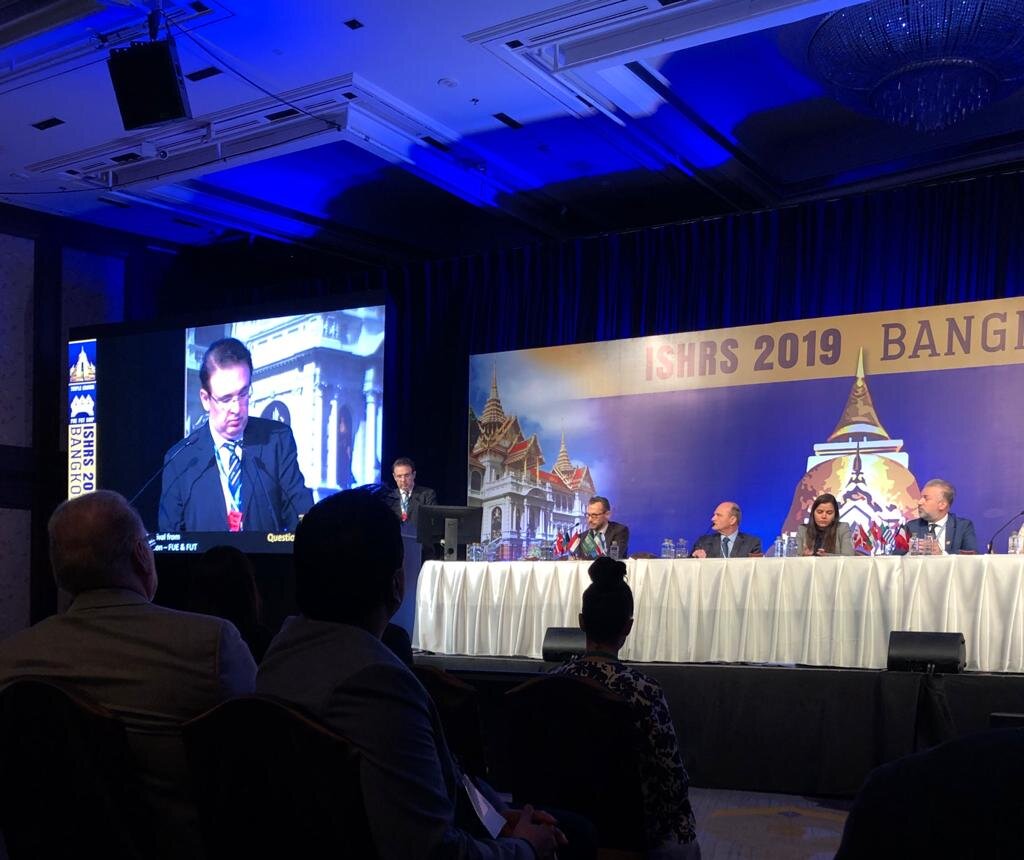
In session.
The trip itself was easy. I always enjoy these long haul flights with no internet. I get so much stuff done it’s not even funny! Just me and my books, my pen and journal, my offline email (on which I can actually clean up the inbox!), a couple of movies, etc. So yeah, I don’t want in-flight internet. Not having wi-fi for a set amount of time is actually rather enjoyable.
I try to arrive one or two days earlier to do some sight-seeing as when the congress starts it gets pretty intense, pretty soon. There’s just so many people that I’m so glad to see and hang out with that, along with the sessions, visiting exhibitors, keeping an eye on how things are going back at the clinic and how patients are doing, I barely have time to get a little workout in.
The congress itself was pretty good. There were some new topics and some not so new ones. Some things that I thought were super simple but important, such as the presentation on ergonomics (with live audience exercises!). That was a fun one. Ergonomics is something I worry about quite a bit and I do take care of my body since surgeries can be very heavy and take many hours. And since time passes super quickly, I sometimes notice I’ve been sitting in the same position for 4 hours! So it was nice to see that there was a presentation on this.
I loved the presentations from Dr. Ramon Grimalt! Super engaging and interesting. Very good and on some controversial topics. His presentations on finasteride and PRP were my favourite ones this year.

Dr. Grimalt’s talk. This slide on Post Finasteride Syndrome was so on point!
And at the end, we always have the gala dinner, which is always fun and engaging as all work is done and we finally get to relax and let loose. Some embarrassing karaoke moments from some of the attendees might have happened, but let’s just say fair play and leave it at that. :D

Hanging out by the pool at the end of the day’s sessions.
After hours, me, Dr. Josephitis and Dr. Pinto and a few others went to the most unlikely little bar right over the river. I’m not even sure if the light was on! Haha The locals were super friendly. They had a guitar with them and I even played and sang a bit with them. Good fun.
The night ended with the concierge taking us on golf-kart ride around the vicinities of the hotel (not even sure how that happened!).

Coffee time at the gala dinner.

Looking at the Wat Arun temple.
On the last day before my flight, me and my good friend Dr. Pinto went to do some sightseeing and, of course, went to get a Thai massage. We found Dr. Josephitis there who was basically addicted to massages at this point! :D The woman who did my massage was super friendly. That woman proceeded to “destroy me”. She bent me in ways I though I could not be bent! I never though someone so small could be so strong.

Dr. Josephitis, myself and Dr. Pinto.
All in all, a great congress. This year sadly there won’t be a live meeting, but a virtual one. Once again I’ll be part of the faculty in the FUE Basics course, albeit in video form. Honoured to a be part of it.

Overlooking the beautiful city. Bangkok has amazing rooftops.
Until next time!
(Hopefully in a shorter time period than the last blog.)

Beautiful lunch view from this restaurant.

What is FUE Hair Transplantation?
If you’ve recently been thinking and/or researching about hair restoration, alopecia and it’s related subjects, or simply become curious about hair transplant surgery, there’s an acronym you’ve probably seen a lot. It stands for something that used to be regarded as a novelty, an experiment with no practical use as it looked way too hard to perform and time consuming. It has quickly evolved and developed over time to become one of the biggest revolutions seen in this field, ever. That acronym is FUE.
So what is FUE?
Well, first we should discuss what a hair transplant is. Hair transplant is a pretty self-explanatory term. It is, in the most basic sense, a way of transplanting, i.e. moving (trans-plant), hair from one part where it grows to another part where it will continue growing. This is why the term “hair implants” is wrong. It disregards that living hair follicles were obtained from the patient himself.
So, this answers one of most common questions people ask me about hair transplants:
- Where does the new hair come from?
The answer is: yourself. And the hair isn’t actually “new”. It’s the same hair you carried with you throughout your whole life. We just harvest it from areas of your scalp/beard/body (we call these “donor areas”) where there is enough hair to spare. It’s an autologous hair transplant.
- Can’t you get it from someone else?
- No.
- Why not? You can transplant a human heart, you should be able to transplant anything.
- Because human organ transplants are reserved for life-saving procedures. They have a fair amount of significant implications. You don’t just pop a new heart into someone’s chest, say “Ok, off you go!” and call it a day. You have to put them on immunosuppressant medication to prevent rejection. For life! Medication that opens the door to all sorts of problems. So we don’t do it for hair. (There is an exception to this though, for ultra-compatible, identical twins. Dr. Alex Ginzburg from Israel has successfully transplanted hair between identical twins.)
FUE - Follicular Unit Extraction, recently renamed Follicular Unit Excision by the ISHRS* - is a surgical method of extracting naturally occurring groups of one to four/five hairs (called follicular units) from the scalp or other parts of the face and body for later transplantation into areas where they are wanted/needed. This is usually done using a circular scalpel, called a punch. The reason it’s called a punch is because it makes a tiny “hole” on the skin, kind of like on an old punch card. These punches nowadays measure anywhere between 0.65 and 1.0 millimeters in diameter. That’s just slightly above the thickness of a credit card so, very small. What this means is that hair follicles are extracted “one by one”. That’s right, thousands of grafts are excised from the patient’s donor area, one at a time.

One of my patients right after extraction. These little incisions will heal very quickly and become almost imperceptible in 10-15 days.
FUE contrasts heavily with the more traditional Follicular Unit Strip Surgery (FUSS) which consists in cutting an elongated and fairly narrow strip of scalp skin (with hair, of course), usually in the occipito-parietal area and then suturing everything back up. This strip of skin is then divided under a microscope into follicular units similar to those extracted with FUE for implantation. There are quite a few doctors very skilled in this technique, like Dr. Hussain Rahal (Canada), Dr. Ron Shapiro (USA) or Dr. Jerry Wong (Canada). It has it’s advantages and drawbacks, but this post isn’t about comparing the two, so we’ll leave that for a later date.
Manual or Motorized?
FUE can either be done using a manual or motorized technique. There is also a third one - robotized extraction - but we’ll leave that one out for now, as it still hasn’t matured enough to be comparable to the previous two.

One of my favorite rotors. Super simple.
Manual extraction relies on the surgeon’s hand motion to make the incision, meaning the surgeon has to oscillate or rotate the punch in such a way to facilitate cutting the skin. It can also be done with no axial movement, which is called “scoring” the skin - something I’ve seen Dr. Bijan Feriduni from Belgium do very well.
Motorized extraction has a wide range of different instruments and motors and they help facilitate it by the means of mechanical oscillation/rotation, vibration, suction, ultrasound, etc. It seems that every year something new in this category of instruments pops up. I kinda find it hard to keep up with trying every new little gadget. But I try.
Being “motorized” does mean that the learning curve for practicing FUE is lowered. It doesn’t require as much skill, finesse or dexterity as manual extraction. You get less tired and you can use a blunt or non-sharp punch, which is more forgiving.
FUE does require a fair amount of precision if you’re going to do an even half-decent extraction. Motorized extraction means that the “price of entry”, so to speak, is lowered. What it doesn’t mean is that you don’t have to still be really skilled with it to get high quality, integral grafts and high hair per graft ratios. Hair per graft ratio is the number of hairs per extracted follicular unit. This ratio heavily affects the result of a hair transplant as it will affect hair density and coverage. There are a lot of other variables that influence the quality of the extraction, not only in terms of graft quality, but also in donor area management. I’ll describe those in detail in a later post.
When I first started in hair restoration, I started doing surgery manually with the very basic but very reliable versi handle, using 0.9mm and 1.0mm punches (and even 1.1mm, although very rarely). I did strictly manual for about 4 years. Then the clinic I worked at starting having motorized extraction machines and I slowly progressed more towards motorized extraction. It was not without some resistance (from my part) though. I had gotten to a very high level of skill and speed with the manual technique and when I tried it, I wasn’t as good with it as I was with the manual.
Looking back in retrospect, I can’t help but think to myself: “But of course I wasn’t as good with it. I was trying the damn thing for the first time!”
Anyway, I started doing surgeries with manual and motorized 50-50 and started to see the benefits. Especially in big cases where my hand would start to get tired, I’d just comfortably cruise along with the machine. And it didn’t take long before I could extract way quicker with motorized, with all the added benefits that brings.
Nowadays I extract almost exclusively with the motorized punch but like to keep a manual punch on the instruments table just in case. I’ll extract a couple of hundred with it from time to time just to keep my hands accustomed to it. Relying on a machine to do surgery is in some medical fields inevitable, but in FUE hair transplant surgery it isn’t. So it’s always comforting to know that, just in case something goes wrong (and it will) and your rotor fails or you have a power outage (and you will), you can always resort to good ol’ manual extraction. Of course I have spares for everything, but I’ve seen multiple units fail in the same surgery. When you do a lot of surgery, the chances of witnessing something very unlikely go up. Expect the unexpected.
My go to punch is usually the 0.8mm, serrated, stainless steel punch manufactured by Magna Medical. I’ll opt for a different one if I feel it’s the most appropriate choice for the case at hand. There are various donor hair characteristics that determine which punch should be used and I bear those in mind when I’m picking one.

The Magna Medical 0,8mm is one of my favorite punches. This is a big mockup.
I do like having all sorts of different punches in my arsenal, like titanium punches, straight edge, ultra-sharp, blunt, unsharp, etc. All for the sake of versatility and readiness. (Also because of the cool factor, I’ll admit. haha)
Extraction
To this point, I’ve only talked about making incisions before extracting the grafts. So how do you actually get them out?
With forceps. There there is also a panoply of different instruments and gizmos to do that.
I personally use 7A and 5A forceps (the 7A on the right hand and the 5A on the left). The 7A is curved and the 5A is more or less straight. I like the asymmetry as it feels to me more versatile and doesn’t cram my hands as much in the operating field. Dr. José Lorenzo from Spain for example, uses two 7A forceps with a very coordinated and fluid technique. Dr. Emorane Lupanzula from Belgium uses his own modified forceps to hold the grafts along with a small 5S forceps to extract them.
There are various different techniques to holding the forceps and different technical gestures to release the grafts. I should get into that in a different post. The key element here is a simple one: don’t damage the grafts and don’t let them desiccate.
That, in a nutshell, is what FUE is about. There are so many things about it I could get into in detail, but this is supposed to be a broader discussion. If you have any questions, feel free to leave them in the comments.
*ISHRS - International Society of Hair Restoration Surgery